

Damage type
Repairing a crack or hole in the hull
A misjudgement while berthing, a pile that does not give, or a shallow that was not on the chart. Once the laminate is open it is not only a cosmetic problem: the hull loses strength and water gets into the laminate. The sooner it is closed, the smaller the repair.
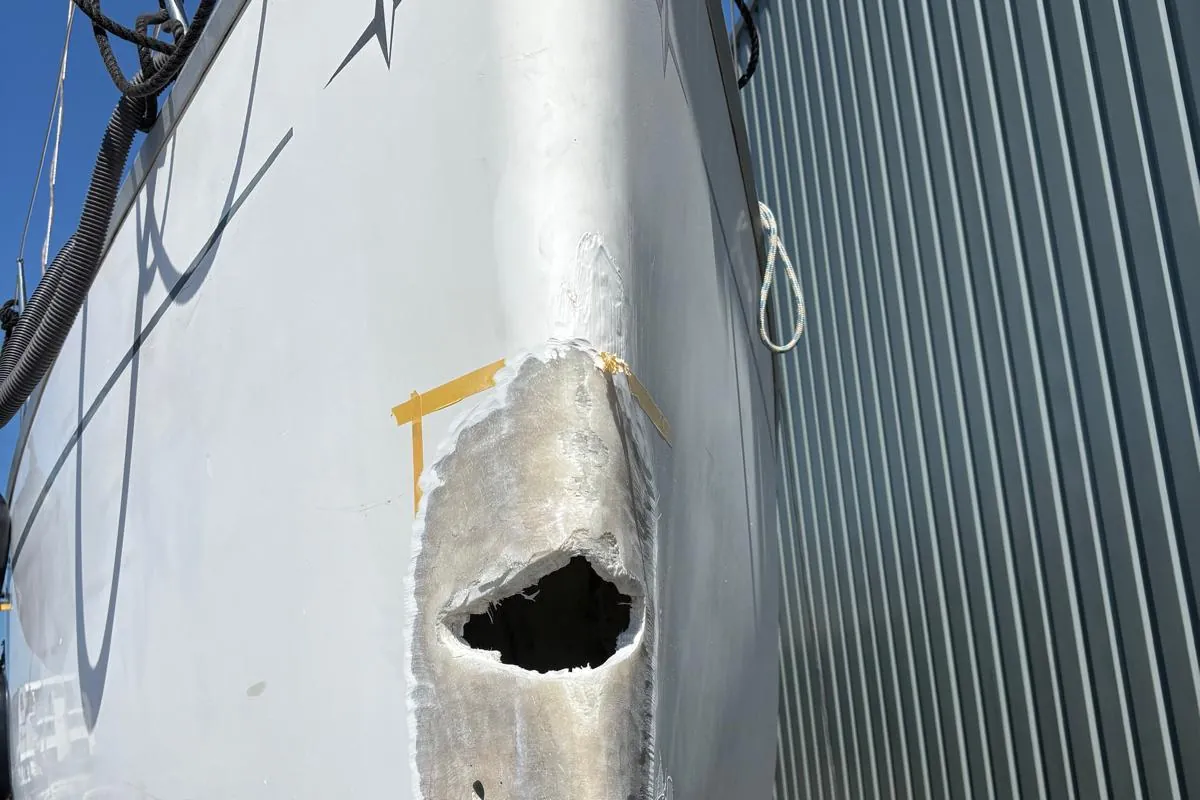
How to recognise it
- A visible crack or hole, with ragged white material at the edges
- A dent or split exactly where you struck something
- Edges of the crack that give when you press them with your thumb
- A crack running further than the impact itself, often under the gelcoat
How we tackle it
- 1
Establish the extent
Damage in polyester almost always runs further than you can see from the outside. We tap out the area and find the edge of the sound laminate.
- 2
Grind back to sound material
The damaged layer is ground away in a taper, so the new laminate gets a large bonding surface. This is the work that decides whether the repair holds.
- 3
Build up in layers
Glass mat and cloth are built up layer by layer with resin, until the original thickness and strength are back.
- 4
Finish in colour
Filling, gelcoat in the colour mixed for your boat, sanding and polishing until the join can no longer be found.
Frequently asked questions about crack or hole in the hull
Can I still go out with a crack in the hull?
Above the waterline and superficial: usually yes, as long as you keep it dry. If the crack goes through the laminate or sits below the waterline, no: the laminate takes up water and the damage spreads every time you go out. If in doubt, send a photo before you start the engine.
Why is the repair bigger than the crack itself?
For a new layer to bond, the damaged laminate has to be ground back in a taper. The rule of thumb is a taper of roughly eight times the layer thickness on each side. On a hull of six millimetres that is five centimetres per side, so a crack of five centimetres soon gives a working area fifteen centimetres wide.
Will I still see the repair afterwards?
On white and light colours, virtually not. On a dark or heavily faded hull an exact match is harder: the old gelcoat has had years of sun and the new material has not. We mix the colour on your hull and work with test pieces, but we do not promise an invisibility we cannot deliver.
How quickly do I need to act?
As long as water can get into the laminate, the repair gets more expensive every week. Moisture in the laminate means extra drying time and sometimes delamination. Closing it up is more urgent than making it look good.
Damage to your boat? Send a photo.
A photo and a short description are enough to assess the damage. Then you hear what is needed and get a quote to suit.