

Damage type
Osmosis and blisters on the underwater hull
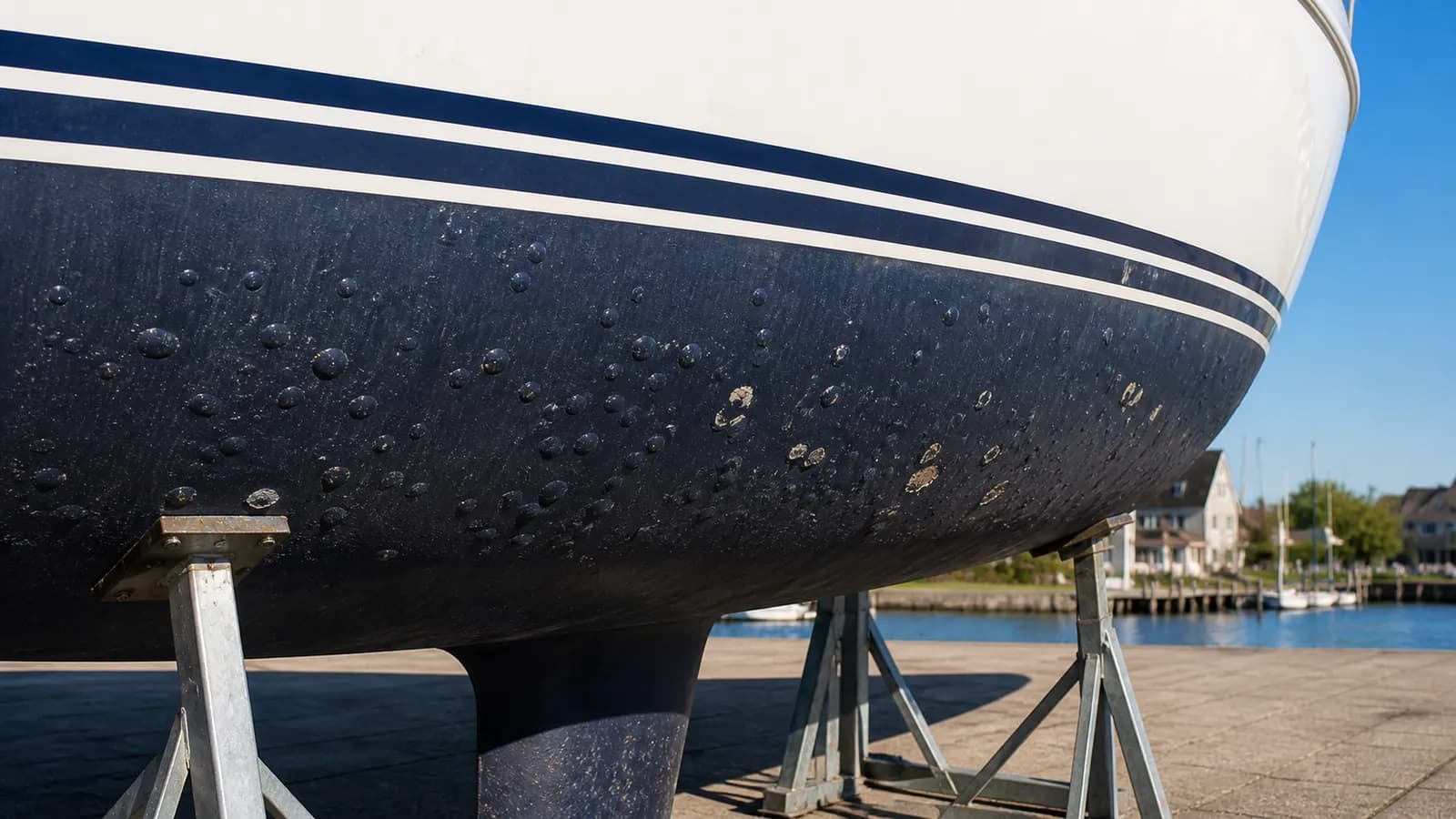
Osmosis happens when moisture works through the gelcoat and starts to react in the laminate. The result is blisters on the underwater hull, sometimes one, sometimes hundreds. Osmosis is rarely an immediate danger, but it never clears up by itself and the repair gets more expensive every season. Honestly, up front: this is winter work, not an afternoon's job.
How to recognise it
- Blisters or bumps on the underwater hull, visible as soon as the boat is out of the water
- A sour or vinegary smell when a blister breaks open
- Moisture returning to a spot that had just looked dry
- An underwater hull that still has not dried through after the winter
How we tackle it
- 1
Measure before we do anything
First a moisture reading across the whole underwater hull. That decides whether it really is osmosis, how deep it sits, and whether the whole hull needs treating or only one area.
- 2
Open up and rinse
Antifouling and gelcoat come off, blisters are opened and the laminate is rinsed until the acid is out.
- 3
Drying, and that takes time
The laminate has to dry below the limit before anything at all may go on it. That takes weeks to months, depending on thickness and weather. Skip this step and you do the job twice.
- 4
Build up and seal
The laminate is repaired and sealed with an epoxy barrier coat, followed by primer and antifouling.
Frequently asked questions about osmosis and blisters
How do I know whether my boat has osmosis?
You see blisters on the underwater hull as soon as the boat is out of the water, and when one breaks open moisture comes out with a sour, vinegary smell. Only a moisture reading across the whole underwater hull gives certainty; blisters can also come from poor antifouling adhesion.
What is the difference between wicking and structural osmosis?
Wicking is very small blisters, usually around the waterline, and that is the mild form. Structural osmosis shows as blisters of roughly five to fifty millimetres spread across the underwater hull. The second calls for a full treatment, the first often does not.
Do I have to have osmosis treated straight away?
Not always. Osmosis is rarely an immediate danger, and a boat with mild wicking can sail on for years. But it never clears up by itself and the treatment gets more expensive every season. The honest trade-off depends on how bad it is, the age of the boat and how long you want to keep it.
How long does an osmosis treatment take?
Winter work. The drying sets the pace and takes weeks, depending on the thickness of the laminate and the weather; that time cannot be hurried. What it will be in your case, you will hear after the moisture reading.
Roughly what does an osmosis treatment cost?
An osmosis treatment is calculated per square metre of underwater hull. What it will be for you depends on how bad it is, how much has to come off and how long the drying takes. Send photos and the dimensions of your boat and you will get an indication.
Damage to your boat? Send a photo.
A photo and a short description are enough to assess the damage. Then you hear what is needed and get a quote to suit.